Who We Are
St. Paul’s invites all people to share in our parish life and ministries. Jesus loves you, as do we!
God is at work in our world and in our lives through the Gospel of Jesus Christ. In joyful response we will:
- Worship God with the riches of Episcopal sacraments, ceremony, and song;
- Encourage one another to pray, learn, and grow in the life of the Spirit;
- Nurture a community of compassion, welcome, inclusion, and warmth
- Seek and Serve people in need in our neighborhood and the world.
In the name of Jesus Christ our Lord, we invite all people to share in our parish life and ministry, including people of every race, color, ethnicity, national origin, sexual orientation, gender identity and expression, and ability.
 A Brief History
“St. Paul’s Church or Congregation in the City of Albany” was formed in the year 1827. We’ve worshiped in four different buildings in four different neighborhoods, all within the City of Albany. Our history is intimately tied to the history of this city.
St. Paul’s is the city’s second Episcopal congregation. Organized by The Rev. Richard Bury, then rector of Christ Church, Duanesburg, and two friends who saw a need in Albany’s rapidly growing South End neighborhood for an Episcopal Church more conveniently located for current members of St. Peter’s Church, and for those looking for a church home. The first meetings were held at the southwest corner of South Pearl and Rensselaer Streets, in an old wooden building that had previously been used as a schoolhouse. After formal organization in November 1827, the first Vestry decided to build a church to be paid for by the sale of pews, the common method at that time. They chose a lot on what is now the corner of Ferry and Dongan streets and hired Philip Hooker to design a building. The structure was dedicated on August 24, 1839. From the beginning, the young congregation faced financial difficulties. Albany’s South End did not continue to grow as expected, and the building remained on the city outskirts. More important, few of those joining St. Paul’s were wealthy enough to purchase pews.
The young congregation barely survived its first dozen years. In early 1839, shortly after the arrival of The Rev. William Ingraham Kip, the fourth rector in the church’s short life, matters reached a crisis. The congregation was forced to sell the building. Kip and a new set of lay leaders chose to leave the South End. They purchased a theater on South Pearl Street in the city’s center and renovated it as a church. The twenty-five years on Pearl Street were happy ones. Situated in an affluent residential neighborhood, with their financial problems resolved, St. Paul’s was able to grow and thrive. During this time, the congregation created a Free Mission Chapel on lower Madison Avenue. Among the many benefits the Chapel provided the community, it offered the first services for the deaf in the city.
By 1862, the neighborhood had experienced significant change. The affluent had moved to the western part of the city leaving the church in what now had become the city’s business district. Plans were underway for a new building farther west when disaster struck: four Albany banks failed within two weeks, and St Paul’s lost its financing for the new building just as it agreed to sell the former theater. Fortunately, the bank failures that created the crisis also created a solution. A Dutch Reform congregation had almost completed construction of a building on Lancaster Street and was unable to pay for its completion. St. Paul’s bought the Lancaster Street building and made it home for the next century.
The period between the Civil War and World War I was a time of prosperity and growth for the congregation. Again, located in an affluent neighborhood, the congregation grew and prospered. With one rector serving from 1864 until 1891, a senior warden serving from 1862 until 1903, and vestrymen serving average terms of thirteen years, the church leadership was very stable. St. Paul’s prosperity and stability was evidenced by a new concern for outreach: including the continued support of the Free Chapel, the founding of St Andrews and St. Mark’s Chapel, and clergy support for Grace Church, Albany and St. Stephens, Delmar. Toward the end of this period, despite financial security, there were signs of stagnation and fear of the future. In a 1902 sermon, the rector spoke of changes that would be required if the congregation was to survive. One option was again moving to a new neighborhood, but that was not practical or financially feasible. In 1906 a revival began with major renovations to the building and a new music program. The congregation also organized a campaign to collect enough donations to create an endowment that would allow the church for the first time to “free the pews” and support itself entirely from pledges.
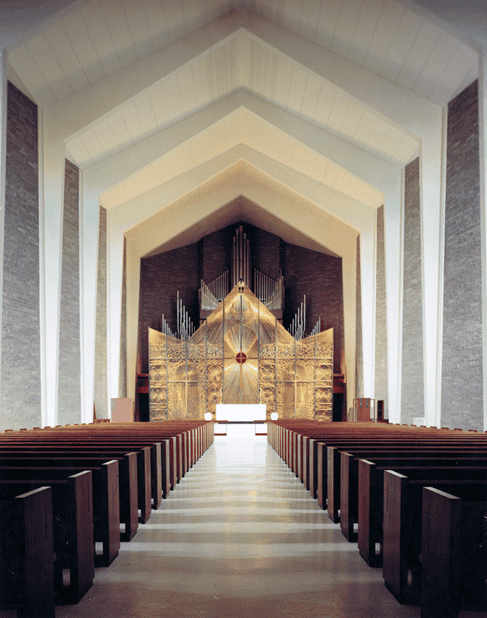 The post-World War II era saw the culmination of social change in the city of Albany. The neighborhood declined, and many of St. Paul’s members moved to the suburbs. By 1958, discussions began about the possibility of the church making yet another move to follow its members, but once again a move was impractical and financially unfeasible. As happened in 1861, a second crisis created the solution for the first: construction of Governor Rockefeller’s Empire State Plaza meant that St. Paul’s would have to move. While leaving their home of a century was painful, reimbursement from the state, and a gift by the diocese of land in the Good Samaritan Center, allowed St. Paul’s to build a large new building on Hackett Boulevard in Albany.
St. Paul’s recently noted the fiftieth anniversary of the consecration of the church building on Hackett Boulevard. We continue our tradition of service, both locally and internationally. We continue the congregation’s long history of support for the Anglican musical tradition in worship and in concert. We look forward to our 200th anniversary in 2027, when we hope to be able to say as Bishop Nelson did in 1927, “St. Paul’s parish is looking forward to a new century of life and of usefulness.”
St. Paul’s Episcopal Church is a parish within the Episcopal Diocese of Albany and a member of the national Episcopal Church. To learn more, please click the links below: